
Unlock the wisdom of your emotions
If you’re human, you’ve been both vexed and buoyed by either your emotions, or the emotions of others. Emotions are powerful – they have the potential to overwhelm us and drive actions we later regret.
But discovery, creativity, co-operation, and compassion — the very heart of what makes us human — is also fuelled by feelings.
As social beings, we constantly read emotions through tone, gestures, and expressions, shaping our every interaction. So if you want to improve any situation, a good place to start is by paying more attention to emotion — both others’ and your own. This awareness unlocks insight, giving you the perspective to make better choices and build stronger connections.
Emotions happen to us
“Don’t be so emotional!” “Get a grip!” “Listen to your heart!” We’re bombarded with mixed messages about feelings. How we relate to emotions — our own and others’ — is also shaped by culture, telling us when and how to express them. Yet, emotions aren’t a choice — they simply happen to us automatically, whether we like it or not. We don’t choose to feel what we feel.
What are emotions?
On his website, leading researcher in emotions, Dr Paul Ekman, describes emotions as a “particular kind of automatic appraisal influenced by our evolutionary and personal past”.
Ekman suggests that it’s better to think of emotions as a process in which we sense that something important to our welfare is happening and so a set of psychological changes and emotional behaviours arise to deal with the situation.
“Emotions prepare us to deal with important events without having to think about them.”
Emotions are adaptive 'tools'
Meanwhile, evolutionary psychology suggests our emotions evolved to help us tackle survival challenges like finding food, avoiding danger, and building social bonds — all of which helped our ancestors’ survival and reproduction. Fear, for example, helps us dodge threats, while disgust makes us turn away from stuff that might poison or infect us.
But if emotions are a universal adaptive solution to problem solving, why do they sometimes overwhelm us, make us wish we could get them under control, or lead to harmful outbursts like uncontrollable anger? Understanding “emotion families” helps unravel this conundrum.
The ABCs of emotion families
Emotions are universal and research suggests that all humans feel between five and seven core emotions — transcending cultures, languages, regional, and ethnic differences.
While scientists debate the exact number, Dr Paul Ekman famously identified seven: anger, contempt, fear, sadness, disgust, surprise, and enjoyment.
But emotions aren’t just single affective states — they’re entire families. Take anger, for example. It ranges from a mild irritation to full-blown rage, including shades, or different forms of anger, like resentment or indignation.
Each emotion unfolds in response to something (a stimulus) like a real event, something imagined, or a memory. Typically, emotions don’t last longer than an hour. When they linger, they shift into moods or, sometimes, what psychologists call emotional disorders.
They will vary though in their onset, duration, and decline. And, although our core emotions are universal, what makes us emotional and how we express that emotion, is shaped not only by our evolution, and culture, but also our personal life stories.
We get to choose our reactions
While we don’t choose the emotions we feel, we do get a choice around our emotional reactions (even if these reactions are informed and shaped by culture, evolution, and experience).
It’s this degree of ‘choicefulness’ that helps us harness the adaptive potential of emotions — even as we navigate our complex modern social landscape (that arguably asks significantly more of us than our hunter-gatherer counterparts).
To gain more choice, we need to build emotional awareness.
Emotional awareness is like having a superpower: it helps us spot our feelings as they happen, understand what they make us do, and recognize the triggers — for ourselves and others. Over time, this insight helps us to shape our emotional reactions in smarter, healthier ways.
No good or bad emotions
Take anger, for example. Typically anger gets a bad rap because it can fuel hurtful behaviour that at its most extreme is violent.
But anger is rarely just anger. It can come mixed with feelings like fear or disgust. Imagine you act out of anger in a way that goes against your values. Along with anger, you might feel regret. If you’ve been taught that anger is “bad,” you might also feel shame or embarrassment for having it.
Instead of labeling emotions as “good” or “bad” or trying to push them away, emotional awareness lets us channel their energy constructively.
Why? Because when you look at what triggers anger, you can see that anger has an important function to play in our lives.
According to Dr Paul Ekman, anger usually flares up when we’re blocked from a goal or treated unfairly. Common anger triggers include:
- Injustice.
- Someone trying to hurt us or a loved one, either physically or psychologically.
- Interference – if the interference is deliberate then the anger can be stronger. Anger can also be felt towards oneself for being unable to remove an obstacle.
- Betrayal, abandonment, rejection.
- Observing someone breaking the law or a cultural rule.
Discernment is key
So when motivated by compassion and expressed wisely, anger can be useful and necessary driving emotional force — key civil rights movements are prime examples of this.
To use anger — or any emotion — constructively, it’s crucial to catch it early, while it’s still a spark, before it grows into a wildfire that can harm ourselves or others.
Mindfulness and compassion practices boost our emotional awareness, helping us notice triggers, patterns of emotional behavior, and crucially the first physical signs of emotion as they arise. This is helpful because all emotions, not just anger, are valuable messengers.
By tuning in to them as they surface, we gain more choice in how we respond. This awareness lets us harness their energy for growth, meaning, and fulfillment, adding richness to our lives and unlocking their adaptive potential in today’s complex world.
Emotions, triggers, and needs - two reflections
Insight is the place where we prompt you with questions to catalyse your own ah-ha moments. You can try these activities before musing on the information we share in our blog (Information). Or after.
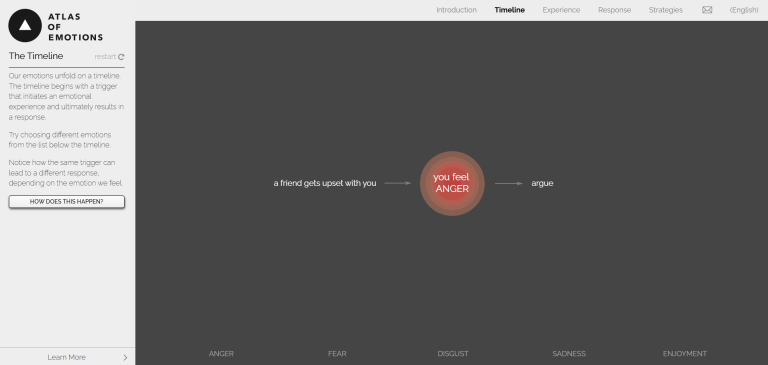
In the first reflection, we invite you to explore The Atlas of Emotion. The Atlas helps you build a vocabulary of emotions, understand families of emotions, as well as how emotions unfold on a timeline with triggers.
In this second reflection, we encourage you to read through this introduction to Marshall Rosenberg’s Non-Violent Communication (NVC) and then try the journalling exercise below.
Ekman's
Atlas of Emotions
As a leading researcher in the field of emotion, Dr Paul Ekman has made understanding emotions and working with them a lot easier for everyone.
His Holiness The Dalai Lama imagined “a map of our emotions to develop a calm mind” and asked his longtime friend, Dr Paul Ekman, to bring this idea to life. So, commissioned by His Holiness, and alongside his daughter, Dr Eve Ekman, the Ekmans took on the creation of The Atlas.
The Atlas of Emotion is a profound tool to help people better understand their emotions. It offers an intuitive and fascinating look at what psychologists have learned from the study of emotion. To learn more about your emotions, click here.
Rosenberg's
roadmap to needs
Emotions are messengers of needs
American psychologist and mediator, Marshall Rosenberg, suggests, inherent in emotion is wisdom that we can tap into. Emotions are messengers of our needs.
For Rosenberg, who developed Non-Violent Communication (NVC), unpleasant emotions — the one’s we don’t typically like feeling — arise because of unmet needs. Pleasant feelings, on the other hand, arise when our needs are met.
Feelings we might have when needs are met
- Amazed
- Comfortable
- Eager
- Energetic
- Fulfilled
- Glad
- Hopeful
- Happy
- Inspired
- Joyous
- Proud
- Relieved
- Suprised
- Thankful
- Trusting
Feelings we might have when needs are not met
- Angry
- Anxious
- Annoyed
- Concerned
- Confused
- Disappointed
- Distressed
- Embarrassed
- Frustrated
- Fearful
- Hopeless
- Impatient
- Irritated
- Lonely
- Sad
Needs are the conditions that humans need to thrive. They include physical needs but also intangible ones like needs for connection, spiritual needs, or the need for meaning.
This list below gives a sense of the some of the universal needs we all share as humans.
Physical wellbeing
- Air
- Food
- Movement
- Shelter
- Water
- Touch
Connection
- Acceptance
- Community
- Respect
- Inclusion
- Intimacy
- Support
Spiritual
- Peace
- Beauty
- Ease
- Harmony
Meaning
- Awareness
- Challenge
- Growth
- Hope
- Purpose
Mapping needs and feelings
Consider this: You might feel fearful when you have a need for physical or emotional safety. Or you might feel joyful when your need to connect with an old friend is met.
We’ll explore this a little further in a journalling reflection.
For now, let’s unpack Rosenberg’s thesis a little more.
We illogically make others
responsible for our emotions
When we identify the needs that our emotions are pointing to, we can respond in healthier, more helpful ways. Remember, emotions arise automatically. We don’t choose them (see our blog on emotional awareness under Information). But how we handle them — and what we do next — is up to us.
We often miss this opportunity though because we mistakenly make others responsible for how we are feeling. Imagine this: you’re happily whistling. Unbeknownst to you, someone nearby finds the sound annoying and snaps, “You’re making me mad. Stop whistling!”
I’m not refuting that we’re responsible for our individual actions and behaviour, but we ultimately have no control over how others will respond to us. Sure, your whistling is the stimulus here; the other person’s feeling of anger is the reaction. But in the same scenario, instead of finding your whistling grating, another might have experienced a sympathetic joy.
So while it’s illogical to blame others for how we feel, it’s still nonetheless a common trap. And, when we fall into it, making others the reason for our feelings, its easier for our needs to go unnoticed.
Emotional awareness
helps us identify our needs
So let’s play out this scenario a little further: In reaction to their loud tone of voice and command, your happiness suddenly gives way to shock.
This is your chance to pause and notice your own feelings — the moment when you can catch the spark of your emotional state — before it becomes a wildfire of anger, sadness, shame, or whatever emotion might unfold for you.
Now, instead of blaming the other person or letting their reaction dictate your mood, you take a moment to connect with what you’re needing right now. What need is this sense of shock pointing to?
By tuning into your emotions in moments like these, you’re taking responsibility for your own feelings and giving yourself a moment to tap into their wisdom.
Emotional awareness
can help circumvent conflict
So, here you are, feeling a little shocked — giving yourself just a few seconds to recognise this — and, as you do so, you realise that rooted in this sense of shock is a need for some respect.
It’s this moment of bringing emotional awareness to how we feel, that helps us identify what we’re needing. At this point, Rosenberg also suggests, that we give up making demands of others. Instead, in recognition of our universal aspiration to flourish and avoid suffering, he invites us to share how we are feeling and make requests.
This is a radical departure from making others responsible for our emotions, which fuels judgment and commands like, “Hey, why are you talking to me like that. Watch your tone! Be more respectful.”
A huge degree of the conflict within people, relationships and society, Rosenberg argued, is because we fail to identify the needs driving our emotions, mistakenly blame others for the emotions we are feeling, and then bypass taking responsibility for how we behave, think, and feel.
Emotional awareness
is a portal to joy
Consequentially, we also don’t experience the joy of having our needs met by others, or the joy of meeting the needs of others. NVC invites populating our dialogue and conversation with the naming of feelings and needs in the spirit of mutual reciprocity.
Given the prevalence of emotions in everyday life, and their power over us, there’s a case to be made for learning to identify and name the emotions, in ourselves and others, that we are already intuiting.
For as we tune into, and surface, what emotions and needs are most alive in any given moment, we then get to ask NVC’s most beautiful question: What would make life more wonderful?
As a skill that can be developed, emotional awareness, is therefore a profound invitation. It offers not only greater choicefulness, but also potentially greater fulfilment.
A self-reflection:
Experimenting with identifying needs
In this reflection, we invite you to consider a recent encounter with someone which evoked pleasant emotions.
- Begin by journalling to capture this experience, perhaps with a short beginning, middle, and end.
- Then, reading through the experience, take a few moments to name and identify the emotions you experienced. Write those down too.
- Then, using this list below, see if you can identify the needs that were being met when you experienced this emotion?
It can take some time to connect with a need at first. If nothing immediately comes to mind, sleep on it. Or carry as a question with you, like a small pebble in your pocket that you can turn over and over.
If you’re feeling up to it, consider a recent encounter with someone which evoked some mildly unpleasant emotions.
- Begin by journalling to capture this experience, perhaps with a short beginning, middle, and end.
- Then, reading through the experience, take a few moments to name and identify the emotions you experienced. Write those down too.
- Then, using this list below, see if you can identify the needs that were being met when you experienced this emotion?
It can take some time to connect with a need at first. If nothing immediately comes to mind, sleep on it. Or carry as a question with you, like a small pebble in your pocket that you can turn over and over.
For more extensive feelings and needs lists, visit the Center for Non-Violent Communication (CNVC).
Physical wellbeing
- Air
- Food
- Movement / exercise
- Rest / sleep
- Shelter
- Touch
- Sexual expression
- Safety
- Water
Connection
- Acceptance
- Affection
- Appreciation
- Belonging
- Co-operation
- Communication
- Community
- Companionship
- Compassion
- Consideration
- Consistency
- Empathy
- Equality
- Honesty
- Respect
- Inclusion
- Intimacy
- Mutuality
- Nurturing
- Respect / self-respect
- Trust
- Support
- Stability
- Understanding
- Warmth
Spiritual
- Peace
- Beauty
- Ease
- Harmony
Play
- Fun
- Laughter
- Joy
- Humour
Meaning
- Awareness
- Challenge
- Clarity
- Competence
- Contribution
- Consciousness
- Creativity
- Discovery
- Effectiveness
- Growth
- Hope
- Learning
- Mourning
- Purpose
- Self-expression
Listen for feelings and needs to connect
“… All criticism, attack, insults, and judgments vanish when we focus attention on hearing the feelings and needs behind a message. The more we practise in this way, the more we realize a simple truth: behind all those messages we’ve allowed ourselves to be intimidated by, are just individuals with unmet needs appealing to us to contribute to their well-being.
When we receive messages with this awareness, we never feel dehumanized by what others have to say to us.
We only feel dehumanized when we get trapped in derogatory images of other people or thoughts of wrongness about ourselves. ” ― Marshall B. Rosenberg in his book: Nonviolent Communication: A Language of Life: Life-Changing Tools for Healthy Relationships